Another post featuring something I’ve drawn, read, and listened to.
This week, the third installment in my series of mechanical animals. In these works, my fascination with 19th-century technology meets my love for natural history. Every mechanical animal has a story. Previously, I shared Roosevelt’s Steam Bison and Babbage’s Mathematical Mammoth.
Drawing
The first mechanical animal I drew, however, was The Mechanical Whale.
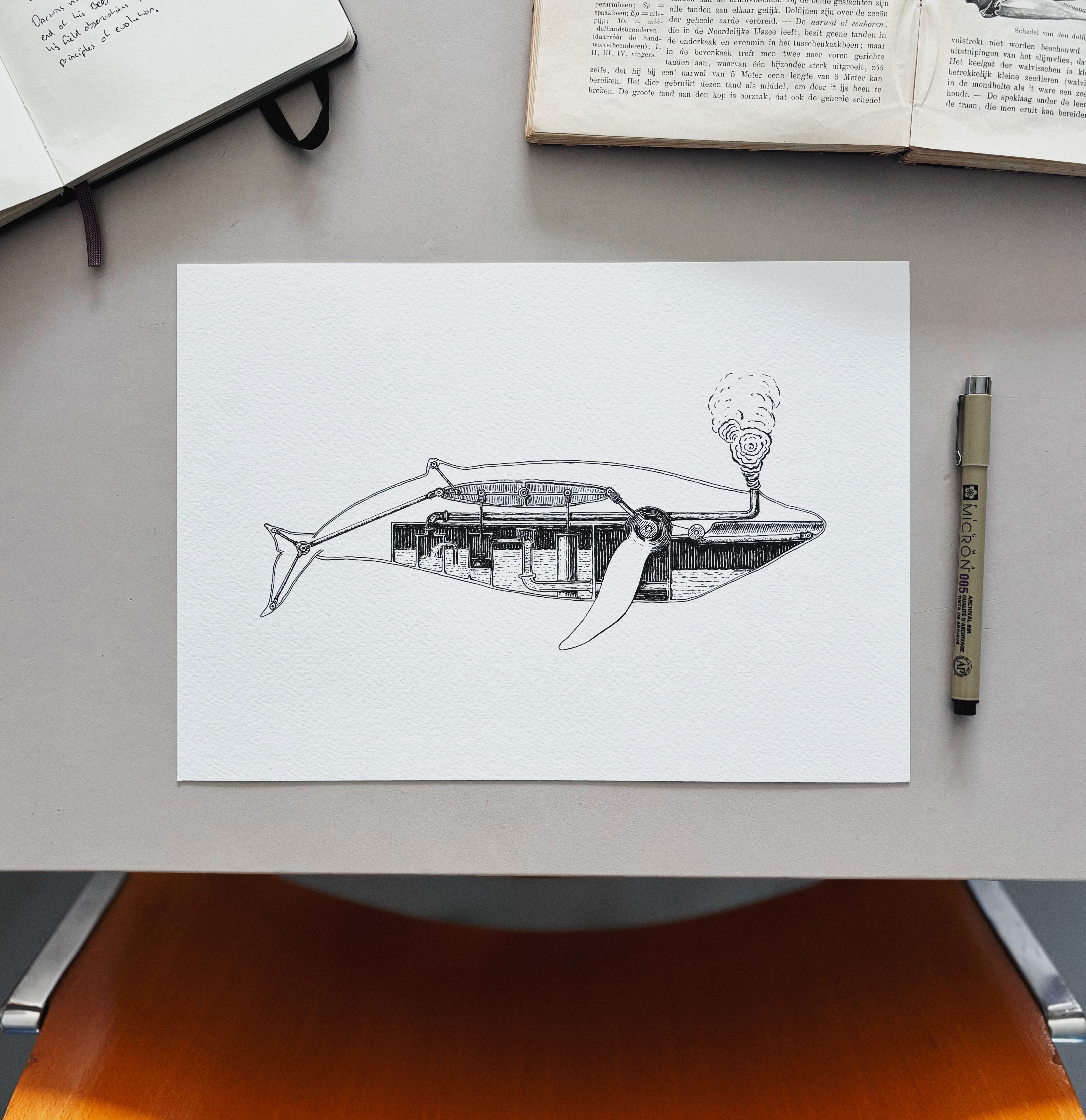
My childhood friend Wietse Hage asked if I would illustrate his master’s thesis for Philosophy of Science, Technology & Society. The focus was on the field of synthetic biology: harnessing nature’s self-organizing power for technology. A robot, however, does what you program it to do, but living systems can evolve and behave unexpectedly. His thesis investigated whether the methods we use to predict the future of technology are actually applicable to synthetic biology, given the complexity of living systems.
Sorry. I can’t make it any simpler than that.
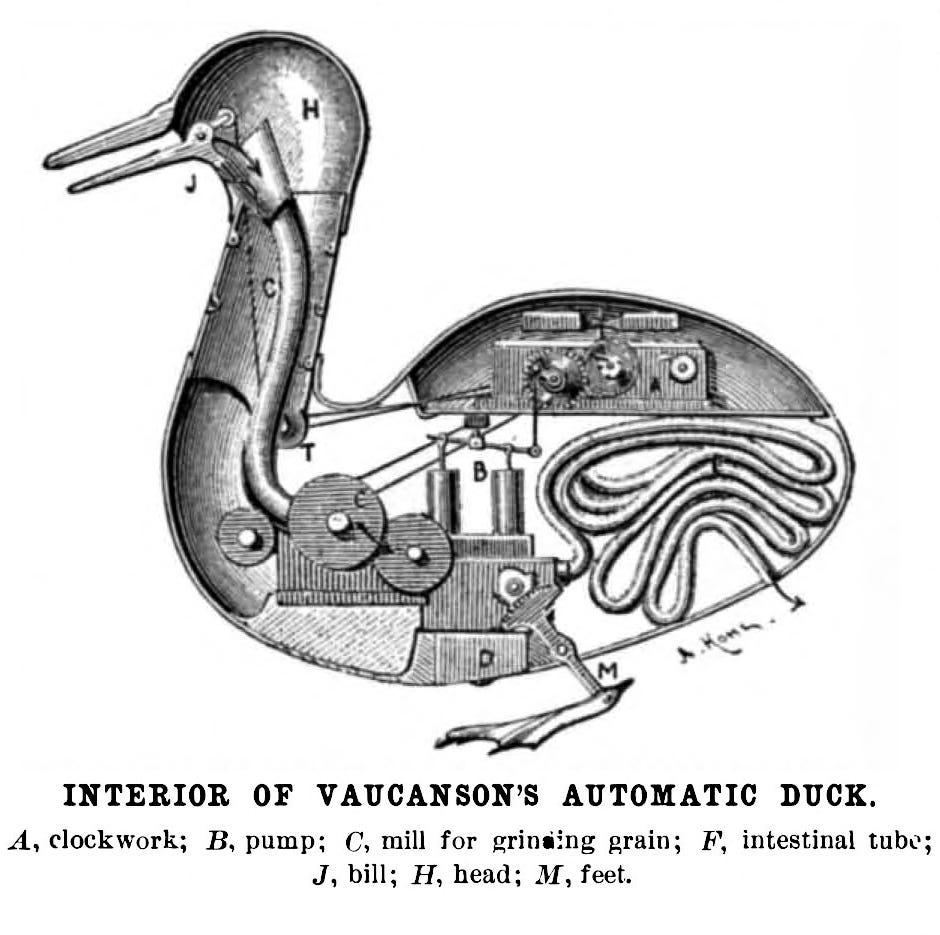
The inspiration for the drawing was the Digesting Duck. The mechanical duck was presented in 1764 by Jacques de Vaucanson. The duck could quack, flap its wings, and appeared to be able to process food. It was, of course, staged. Nevertheless, automatons1 like this one were technological marvels. They were complex systems of gears and springs, even more intricate than many clockworks.
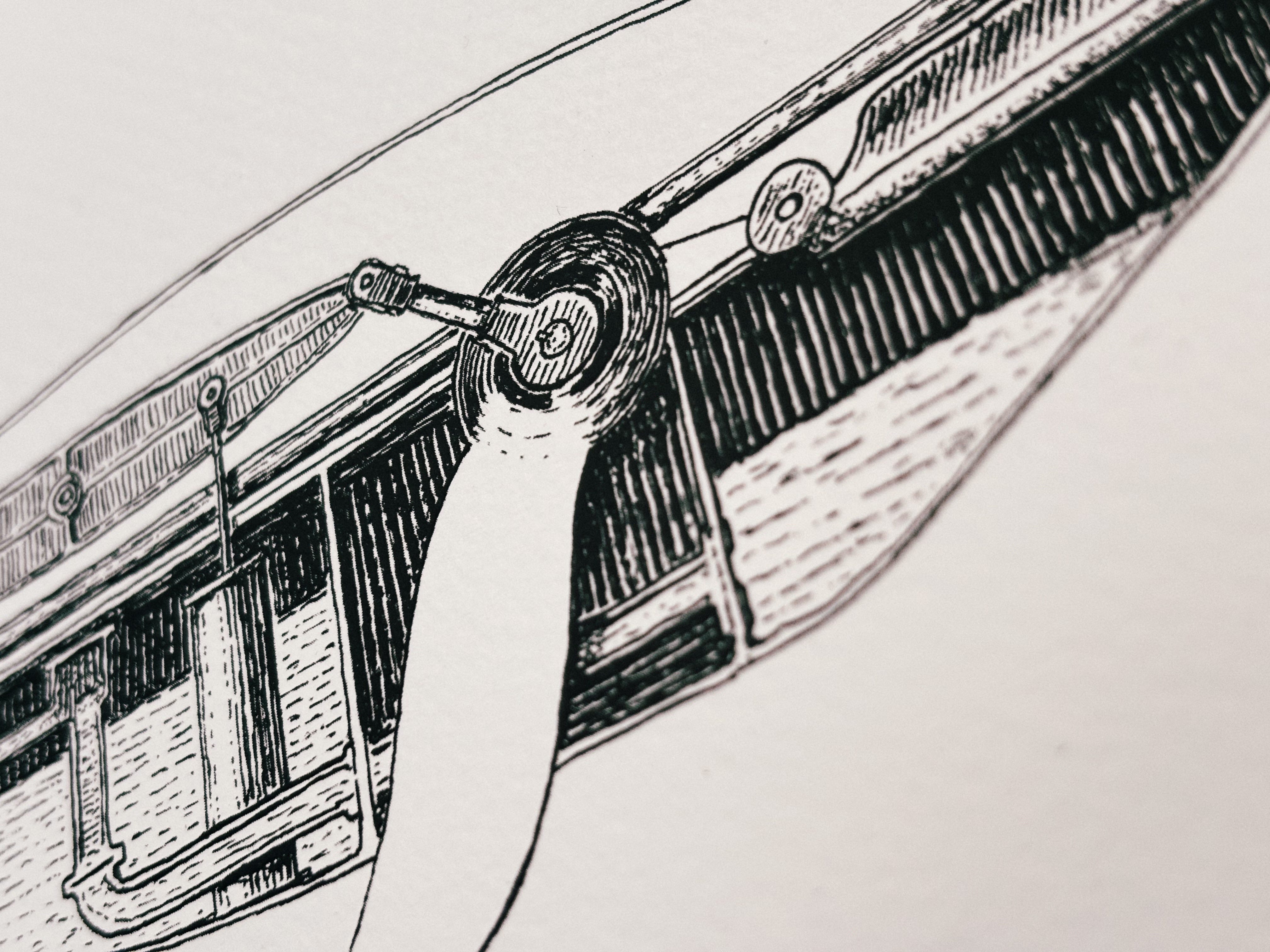
Pumps, gears, and shafts. The Mechanical Whale filters the water and expels it through its blowhole. No actual building is required. The largest and most impressive living system on Earth is already swimming around.
Read
The digesting duck was not the first mechanical animal. In Walter Isaacson’s biography of Leonardo da Vinci, I read about his mechanical lion. Leonardo created this lion in 1515 to greet King Louis XII in Milan. Both the lion and the drawings have been lost. According to accounts, the reclining lion stood up upon the king’s arrival and opened its chest with its paw to reveal a bouquet of lilies.
Throughout his life, Leonardo da Vinci drew much inspiration from nature for technology. “Study the anatomy of a bird’s wings along with the chest muscles that move those wings,” Leonardo wrote in his notebook. “Do the same for a man to demonstrate the possibility that a man could keep himself aloft by flapping wings.”
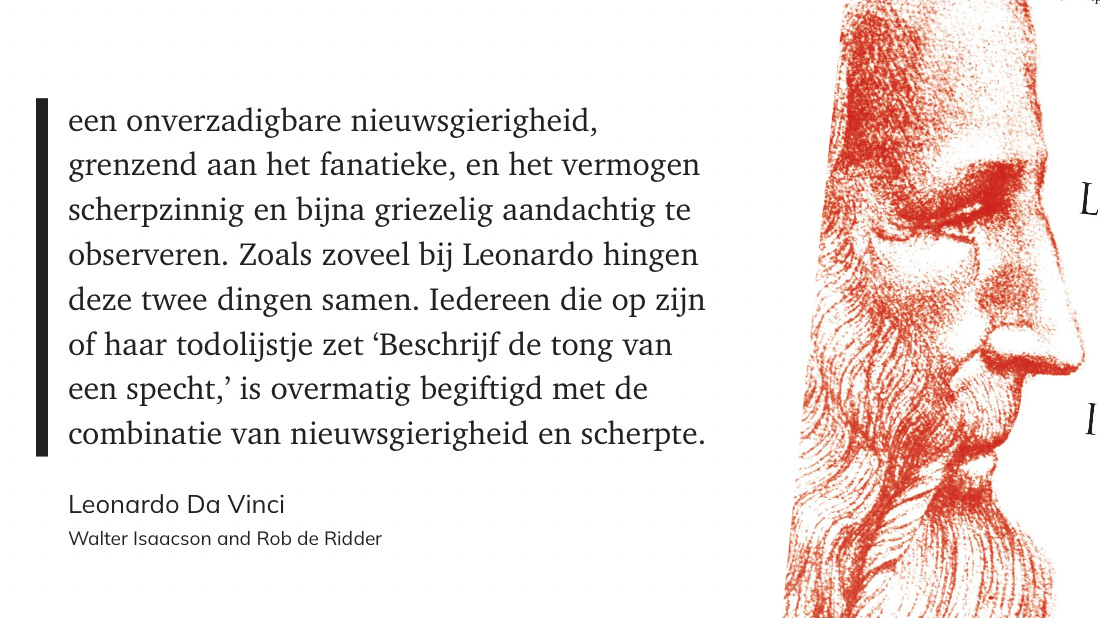
His world-famous notebooks are filled with observations of nature and questions. Isaacson, for example, is surprised by one of his notes: “Describe the tongue of a woodpecker.”
Listen
For many, that boundless curiosity makes Leonardo the greatest inventor of all time. In the British podcast *You’re Dead to Me*, Irish comedian Dara Ó Briain completely derails the conversation by portraying Leonardo da Vinci as a con artist who never finishes anything. Regarding his mechanical knight and lion: “Oh, so he’s a toy maker now??”. And that gigantic crossbow Leonardo designed? According to Dara, a tiny little man to scale.
History and British (and Irish) humor. Why hasn’t anyone told me about this delightful podcast before?
And, oh yeah, music. Cut Worms collaborated with Jeff Tweedy on his new album, Transmitter. The album makes a slightly less impressive impact than his earlier albums, but his sound still evokes pleasant 70s and George Harrison vibes.
See you next week!
Of course, this wasn’t limited to animals. In 1769, there was a chess-playing machine called the Turk that toured Europe as an automaton. The Turk defeated Benjamin Franklin in a game of chess. The Turk was actually operated by a man hidden inside the machine, so it wasn’t a real automaton.