Another Strook featuring something I’ve drawn, read, or listened to.
Drawing
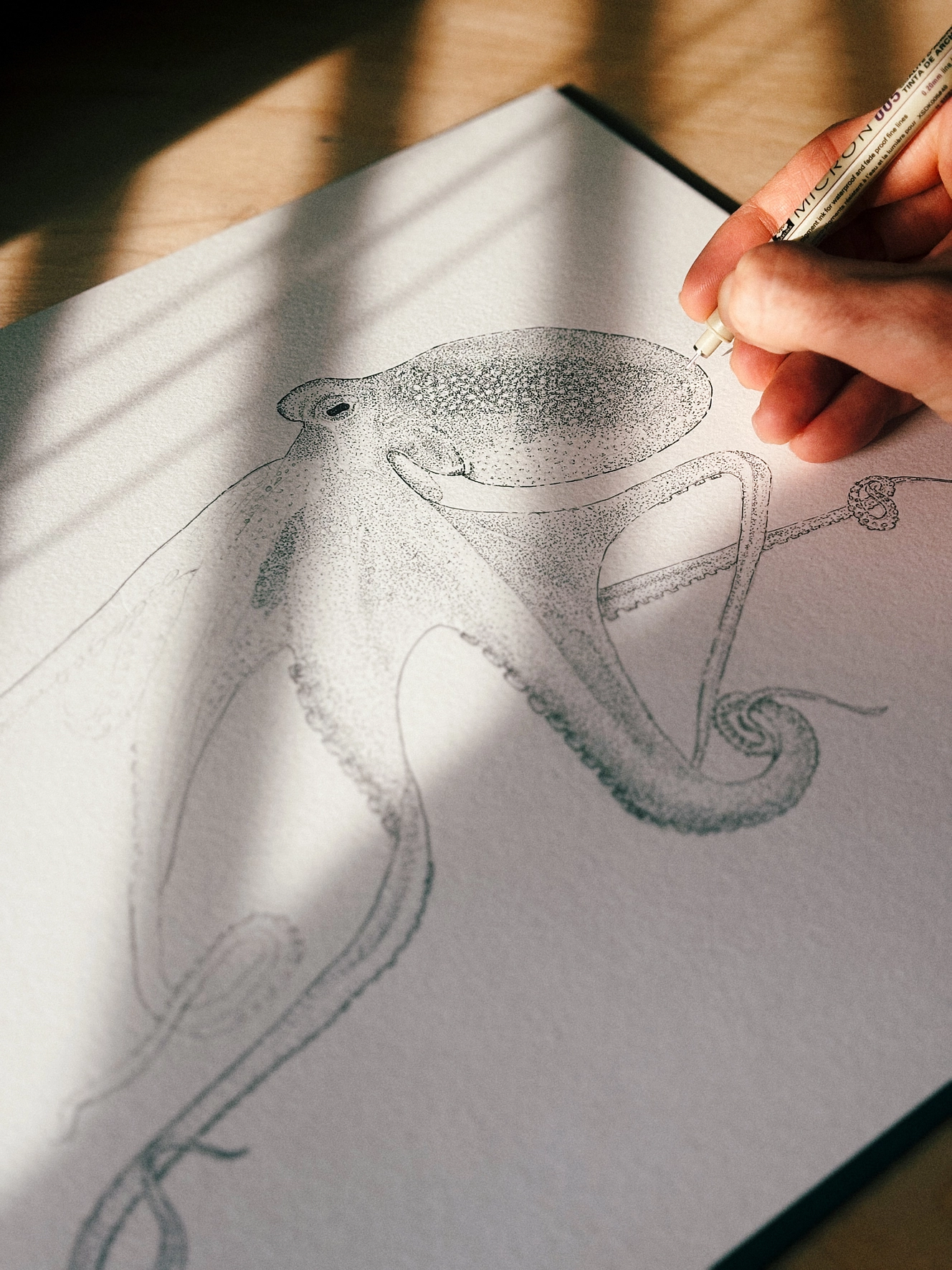
Superintelligence is already here. Somewhere deep in the ocean. The drawn version has been staring at me sternly for months: mark me off. More on the octopus soon.
Reading
The Infinity Machine by Sebastian Mallaby is about Nobel Prize winner Hassabis, DeepMind, and the race toward superintelligence.
As a toddler, Hassabis watches a chess match and learns the game in no time. At age 6, he couldn’t continue playing in the British under-14 tournament. He had fallen asleep at the table. As a teenager, he also had an epiphany at those tournaments. All those brilliant minds wasting their energy on a game board. What a waste of talent. They could also dedicate themselves to science or medicine.
At the age of 18 (!), Demis Hassabis was offered half a million pounds by gaming legend Peter Molyneux. He wanted Hassabis to continue working for him instead of going to college. They had already been working on the computer game Theme Park for a few years, and Molyneux had already seen what no one could deny: Hassabis was brilliant.
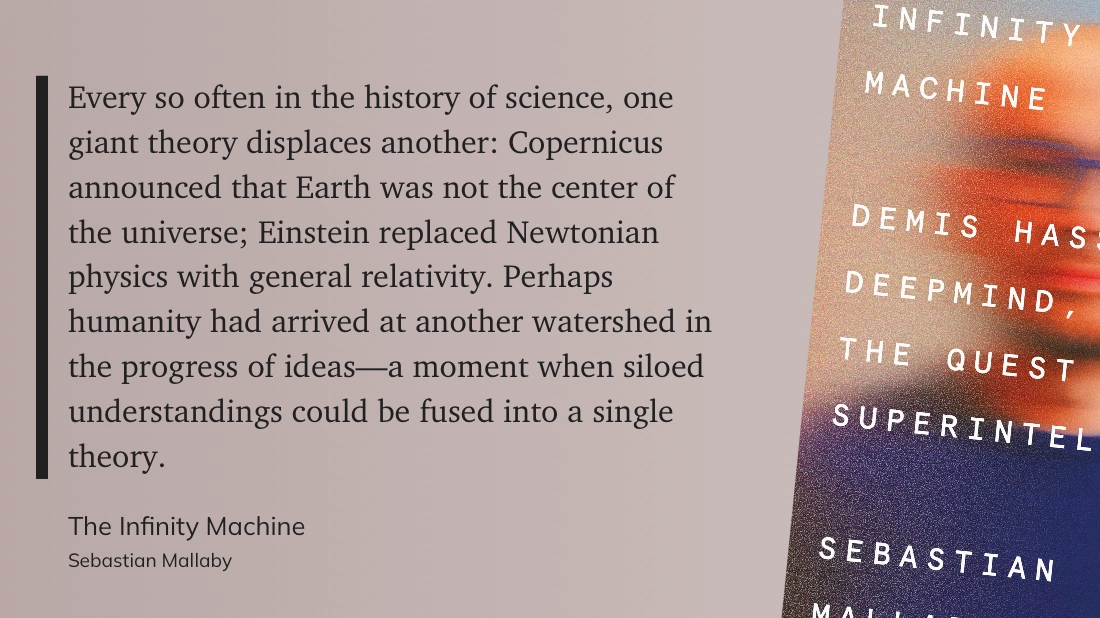
Hassabis turns down Molyneux’s astronomical offer, chooses to pursue his studies, and earns a PhD in neuroscience on how memory works. He believes that all the great inventions the human brain is capable of have already been made. The next breakthroughs will require a new inventor: superintelligence. An AI smarter than the smartest human.
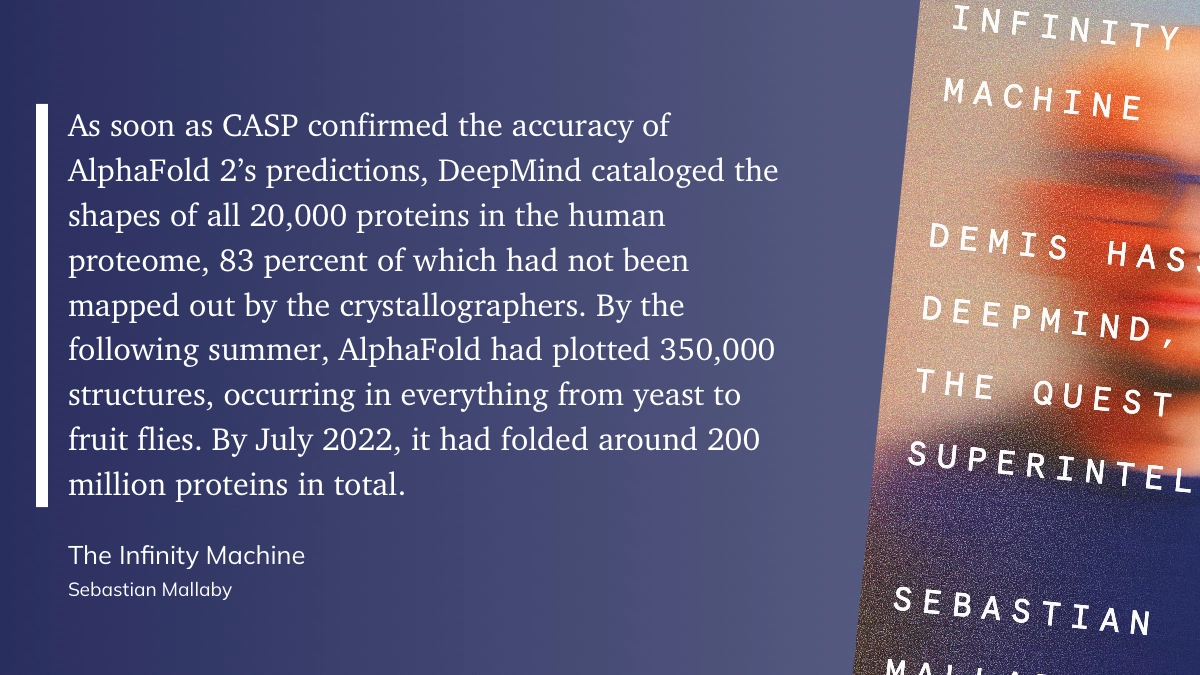
He founded DeepMind with the goal of achieving that. With AlphaGo, they defeated the world’s best Go player1. With AlphaFold, they solved one of the greatest challenges in biology: how the shape of proteins is determined. It takes science decades to unfold a single protein.2 AlphaFold predicts the structure of every protein on Earth in just a few months. A breakthrough for drug development. Hassabis (along with others) receives the Nobel Prize for it.
Thanks to Google’s acquisition, DeepMind can continue to operate as a research lab for years to come. That is its preference, because DeepMind is aware of the significant risks that AI and superintelligence entail. By choosing that path toward safety and science, they allow themselves to be left behind. OpenAI launches ChatGPT. DeepMind has little choice but to follow suit. Meanwhile, AI is increasingly becoming the heart of Google. Thus, Hassabis suddenly finds himself at the helm of both a research lab and a consumer product.
It’s hard not to end this piece with a cliché about “the opportunities and risks of AI.” The book reads like a biography of an extraordinary inventor and a history of the AI developments we’re still fully immersed in. In any case, I learned a tremendous amount about the fundamental choices that make today’s AI models possible. No one knows where that will lead. That’s exactly the problem.
And the grandmaster of Go? After losing to AI, he no longer finds joy in Go and quits. I had to let that sink in for a moment.
Listen
Summarizing a chess prodigy, Go, protein folding, and the rise of AI… without making the newsletter too long. That’s where my words went to describe Hovvdy’s lovely, dreamy music. I Try Try Try.
See you next week!
There are more possible board positions during a game of Go than there are atoms in the universe.
I needed this great explanatory video about AlphaFold, proteins, and amino acids to better understand what I was reading: AlphaFold: The Most Useful Thing AI Has Ever Done
