This is the second part1 in a series of mechanical animals. These works combine my fascination with 19th-century technology and my love of natural history. Each mechanical animal has a story. This time: Babbage's mammoth.
Drawing
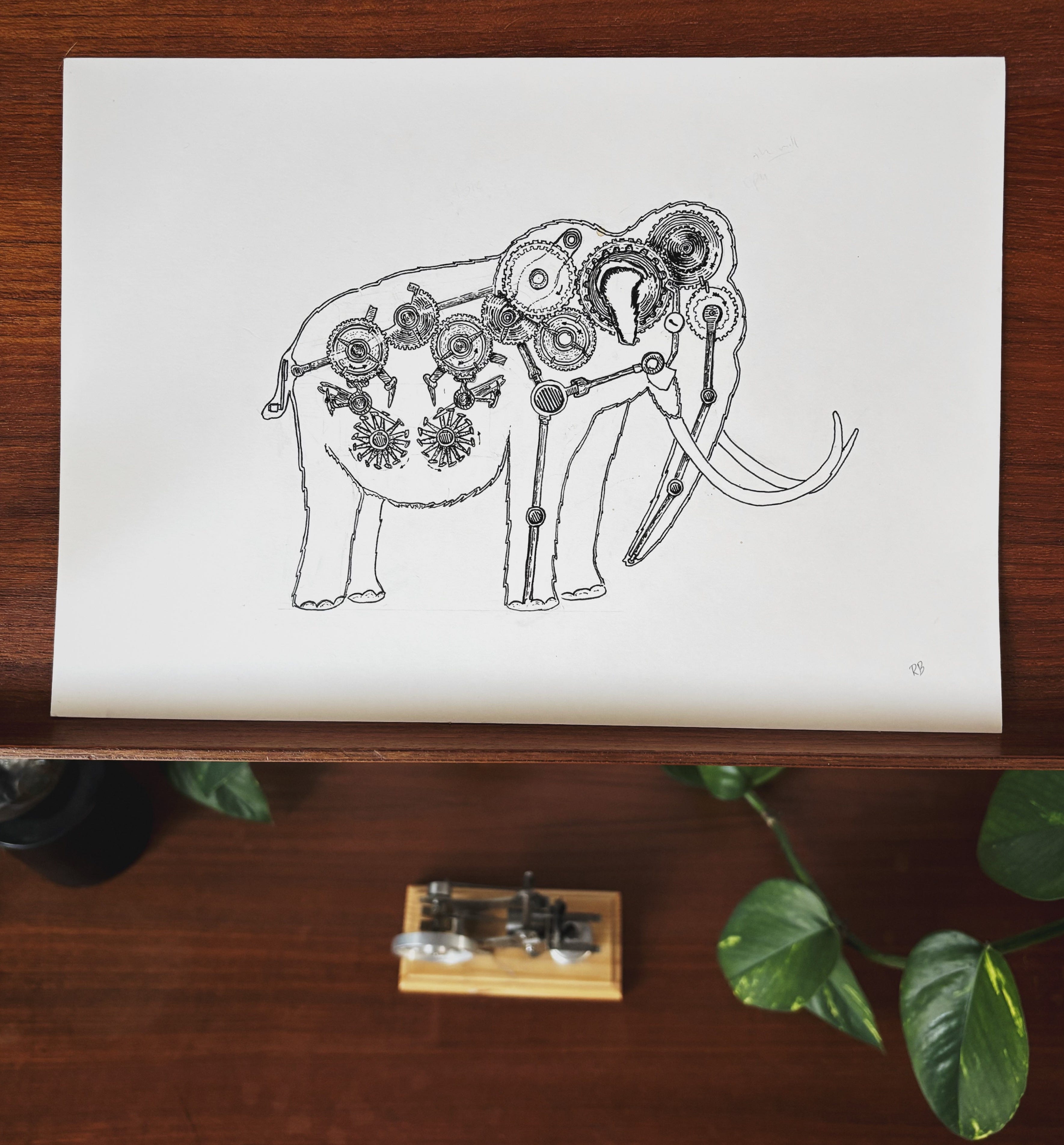
8 meters long, 3 meters wide, 4.5 meters high. A gigantic memory. Powered by steam. Charles Babbage's Analytical Engine was a true mathematical mammoth.
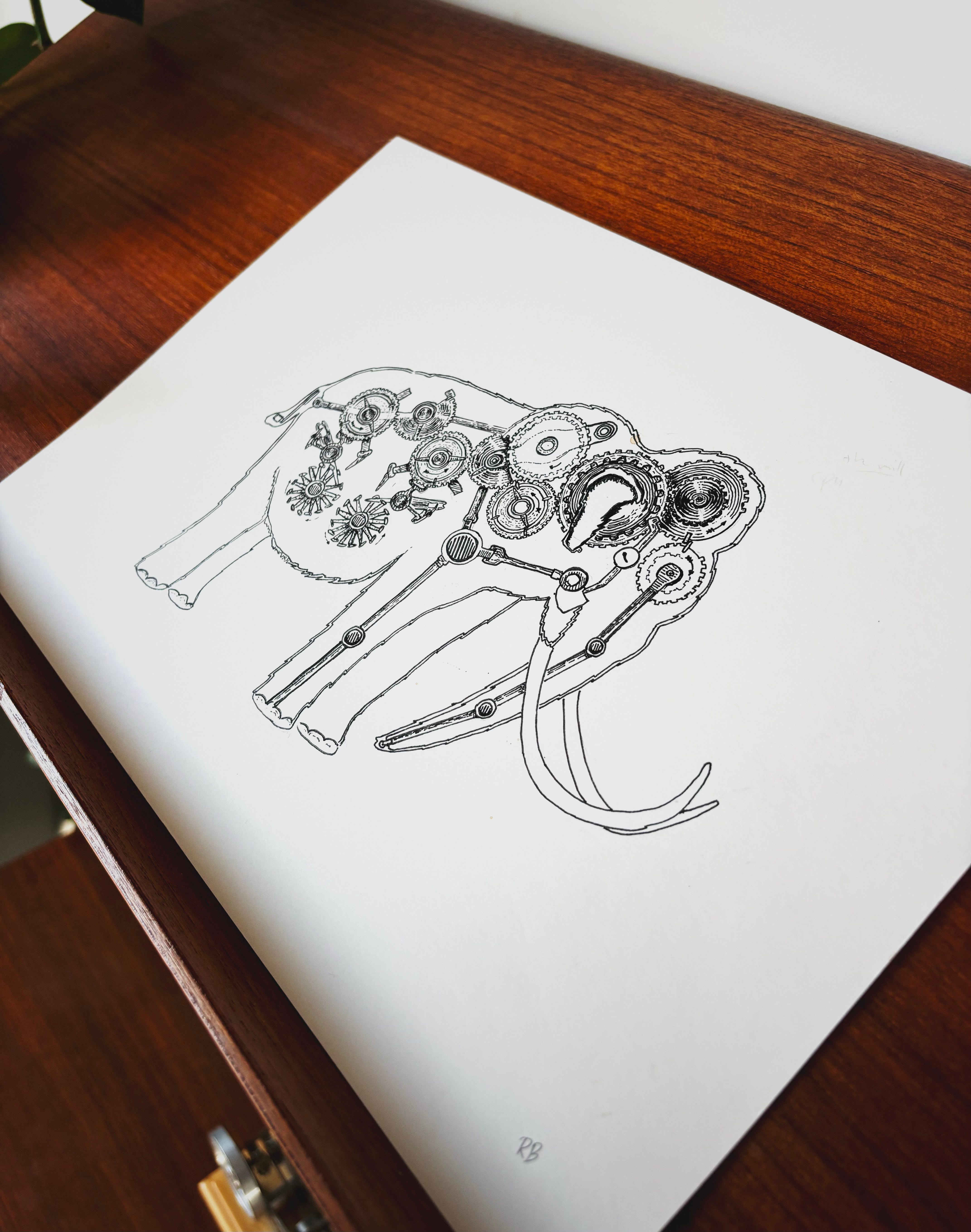
In the mammoth's head, I incorporated parts of The Mill, the part that performed the calculations, comparable to the processor in a modern computer. In its belly, I incorporated the workings of The Store, the memory, where vertical axes with gears stored numbers.
While drawing, I regularly got lost in the stacks of Babbage's reference works and drawings. I never really understood it.
Reading
The Analytical Engine was the first computer. The Inventors, by Walter Isaacson, tells the history of the computer, starting with Babbage's machines and the role of Ada Lovelace. She realized that his machine would be capable of more than just calculations in the future.
The machine was what you call Turing Complete, which means that every calculation can be programmed. On paper, that is, because the machine was worked out in detail by Charles Babbage in the 1830s and 1840s, but ultimately never built. It proved too expensive and too complex.
Sydney Padua, creator of the graphic novel The Thrilling Adventures of Lovelace & Babbage, not only illustrated this remarkable story, but also delved into the workings of the machine. That's how I came across this great explanatory video, which uses Padua's drawing to explain how the machine worked, what it would look like, and what Turing Complete actually means.
I started this drawing almost five years ago. I got stuck and put it away. Still, I wanted to finish it. Every year I picked it up again, but I always got stuck. What exactly did I want to show? I wanted to put too much into one drawing. Even writing this newsletter was a struggle; there is just too much to say about this machine and Babbage.2 Secretly, I am especially happy that it is finally finished. On to something new!
Listen
Where a band like Geese demands all my attention (and energy), Whitney is the exact opposite. Atmospheric piano and guitar music that is always welcome. Like now: a weekend at home with the autumn sun and the new album Small Talk.
See you next week!
Part 1 of Mechanical Animals: Roosevelt's Steam Bison
The Computer History Museum has a well-organized website about Babbage's engines and what makes them so special: https://www.computerhistory.org/babbage/engines